
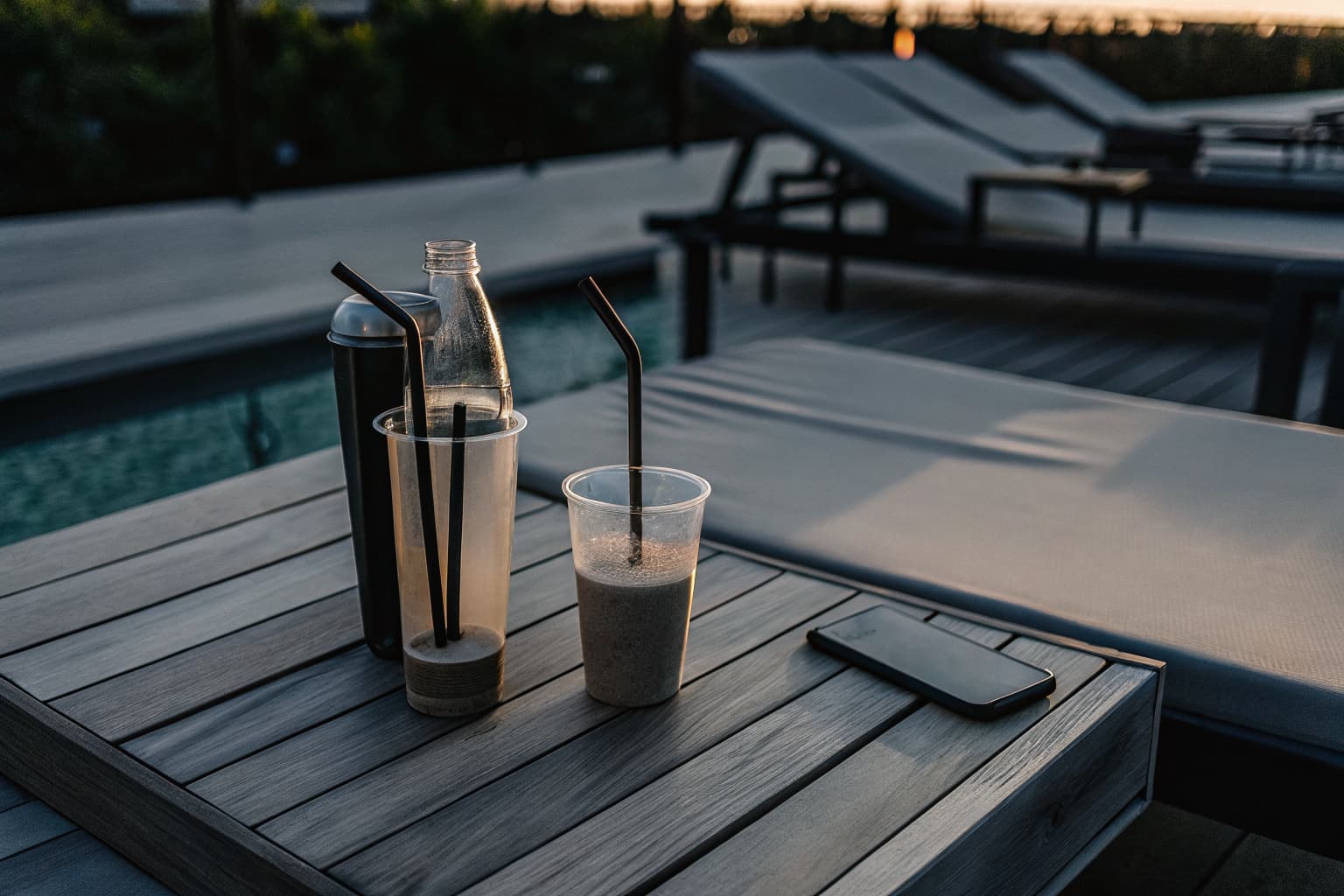
Seventy-three percent of travelers say they prefer to book eco-friendly hotels — but preference doesn't rebuild an operation on its own. Behind every guest-facing amenity is a supply chain of single-use plastic: in-room cups, minibar packaging, pool-deck cups, banquet serviceware, room-service containers, and back-of-house food packaging, all moving through property at a volume most guests never see.
A Hotel Sustainability Program is the structured answer to that gap between guest expectation and operational reality. Rather than swapping a handful of amenities in isolation, it maps every single-use plastic touchpoint across the property — in-room, restaurant, pool and spa, events, minibar, back-of-house — to a certified compostable replacement, then rolls it out department by department with measurable goals attached. Here's what that program looks like in practice, and why hotel groups are moving on it now.
The Scope of Hotel Plastic Waste
Hospitality is unusually plastic-intensive, and unusually visible about it. A single property runs plastic through nearly every guest touchpoint at once — welcome amenities, in-room coffee cups, poolside drinkware, banquet and conference serviceware, room-service trays, and grab-and-go packaging in the lobby market — often multiplied across hundreds of rooms and thousands of covers a week.
Most of that plastic is contaminated by the time it reaches a waste bin — food residue, sunscreen, or beverage remnants — which pushes it past what curbside or even industrial recycling streams will accept. The result is a waste stream that's both large and largely un-recyclable, most of it heading straight to landfill where petroleum plastic persists for centuries.
Guests notice, and increasingly book on it. Sustainability-focused travel surveys consistently show travelers factoring visible plastic use into how they rate a stay and whether they'd return — which makes plastic reduction as much a revenue question for hotels as an operational one.
73%
of travelers say they prefer to book eco-friendly hotels
$12B
lost annually across hospitality to plastic waste and disposal costs
0
microplastics in every certified compostable product used
Why a Structured Program Beats Piecemeal Swaps
Most hotels that attempt plastic reduction start with a single department — usually in-room amenities or the pool deck, since guests see them directly. That's a reasonable first move, but it rarely scales past a photo opportunity. Restaurant and banquet operations, minibar and gift shop, and back-of-house each run on different volume patterns, different vendors, and different guest-facing expectations, and a one-department pilot doesn't answer for any of them.
A Hotel Sustainability Program treats the whole property as one system. It starts with a full audit of every single-use plastic item across every department, matches each one to a certified compostable replacement, and sequences the rollout by guest visibility and volume — in-room and restaurant first, then pool and spa and events, then minibar, gift shop, and back-of-house last.
That sequencing matters for budget and for guest experience alike. Phasing the rollout lets a property absorb the cost of switching over several budget cycles instead of all at once, and it gives staff time to adjust handling and disposal procedures department by department rather than property-wide overnight.

The 6-Step Framework for a Plastic-Free Hotel
Whether a property is a single boutique hotel or a multi-property resort group, the same six-step framework scales to fit the portfolio's size, timeline, and brand-standard requirements.
- 01
Audit Your Property's Plastic Footprint
Survey every department — in-room amenities, restaurant and dining, pool and spa deck, events and banquets, minibar and gift shop, back-of-house — and document every single-use plastic item by type, volume, and current supplier. This baseline defines the program's scope and its measurable impact.
- 02
Map Compostable Replacements by Department
Match each plastic item to a certified compostable equivalent — cups, lids, straws, utensils, clamshell boxes, and bottling that fit the same dimensions and service standards as what's already in use, so the switch is a drop-in replacement rather than a service redesign.
- 03
Set Measurable Sustainability Goals
Define success with concrete targets: "Eliminate 100% of guest-facing plastic by Q2," or "Reduce plastic waste by 60% within 6 months." Tie goals to certifications like Green Key, LEED, or EarthCheck that reward compostable-product adoption.
- 04
Phase Your Rollout by Department
Start with the highest-visibility, highest-volume departments — in-room and restaurant — then extend into pool and spa, events and banquets, and finish with minibar, gift shop, and back-of-house once staff workflows are established.
- 05
Train Staff & Communicate to Guests
Brief housekeeping, F&B, and events staff on new handling and disposal procedures, and surface the change to guests through in-room cards, restaurant signage, and booking-page messaging — the same sustainability story that influenced their decision to book.
- 06
Measure, Report & Certify
Track pounds of plastic diverted per department, per quarter, and feed that data into certification renewals and ESG or brand-standard reporting, turning the rollout into an ongoing, documented result rather than a one-time initiative.
Ad Hoc Swaps vs. a Structured Program
The difference between testing a few compostable cups and running a full Hotel Sustainability Program comes down to whether the property can document, sustain, and scale the change across every department guests and inspectors actually see.
Ad Hoc Plastic Swaps
Strength
Fast to start — a single department can switch products within weeks with no property-wide planning required.
Limitations
Doesn't scale past the pilot department, has no documentation trail for certification audits, and leaves the rest of the property's plastic footprint untouched.
Best For
Properties testing the concept before committing to a full rollout.
Structured Hotel Sustainability Program
Strength
Covers every department on a phased timeline, generates the certification documentation Green Key, LEED, and EarthCheck reviews expect, and produces year-over-year waste diversion data guests and brand auditors can see.
Limitations
Requires an upfront property-wide audit and a phased budget commitment across departments.
Best For
Hotels and multi-property groups pursuing formal sustainability certifications and long-term plastic elimination.
Certification: Green Key, LEED, EarthCheck, and Guest-Facing ESG
Hotel sustainability doesn't happen in a vacuum — it's increasingly tied to formal certifications that both travelers and booking platforms already look for. Green Key certification rewards properties for measurable waste reduction and sustainable purchasing, and a documented certified-compostable product switch is a direct fit for that scoring.
LEED and EarthCheck reviews, used across much of the hospitality industry to benchmark environmental performance, increasingly weight single-use plastic elimination as part of their waste-management criteria. Properties that can point to a documented, phased plastic-elimination program with certification paperwork for every product swapped have a far easier certification conversation than properties relying on informal, undocumented changes.
And for hotel groups publishing ESG reports or responding to brand-standard sustainability audits, a Hotel Sustainability Program produces exactly the kind of quantifiable, year-over-year data — pounds of plastic diverted per department, per property, per fiscal year — that those reports and audits are built around.
Guests choose a hotel for the experience it promises. A dedicated sustainability program lets a property back up that promise with the same standard of care it applies to service and design.
— Pure Form Solution, Hotel Sustainability Program Framework
Getting Started: The Direct Path
The fastest path into a Hotel Sustainability Program starts with the two departments guests interact with most: in-room amenities and restaurant and dining service. Both are high-visibility, easy for guests to notice on arrival, and straightforward to swap without touching housekeeping or kitchen workflows.
From there, the same certified product suite that covers in-room and dining — compostable cups, lids, straws, utensils, clamshell boxes, and bottling — extends into pool and spa deck service, events and banquets, and minibar and gift shop with no additional sourcing required.
Because every product is a drop-in replacement for its conventional plastic counterpart — same dimensions, same service performance, same guest experience — properties don't need to retool equipment or retrain staff on new handling procedures beyond disposal.
A Program, Not Just an Amenity Swap
The hotels seeing the clearest results from sustainability efforts aren't the ones that swapped a few cups by the pool. They're the ones that treated plastic reduction as a property-wide program — audited, sequenced, measured, and certified — the same way they'd approach any other guest-experience initiative with brand-standard requirements attached.
With 73% of travelers stating a preference for eco-friendly hotels and $12 billion lost annually across hospitality to plastic waste and disposal costs, the case for a structured program only gets stronger. The products already exist as certified, drop-in replacements — the program is what turns individual swaps into a documented, property-wide result guests can see and book on.
Whether your property is a single boutique hotel or a multi-property resort group, the six-step framework scales to your departments, your timeline, and your certification requirements.
Explore Pure Form Solution Products
See the full framework in action: Hotel Sustainability Program →