

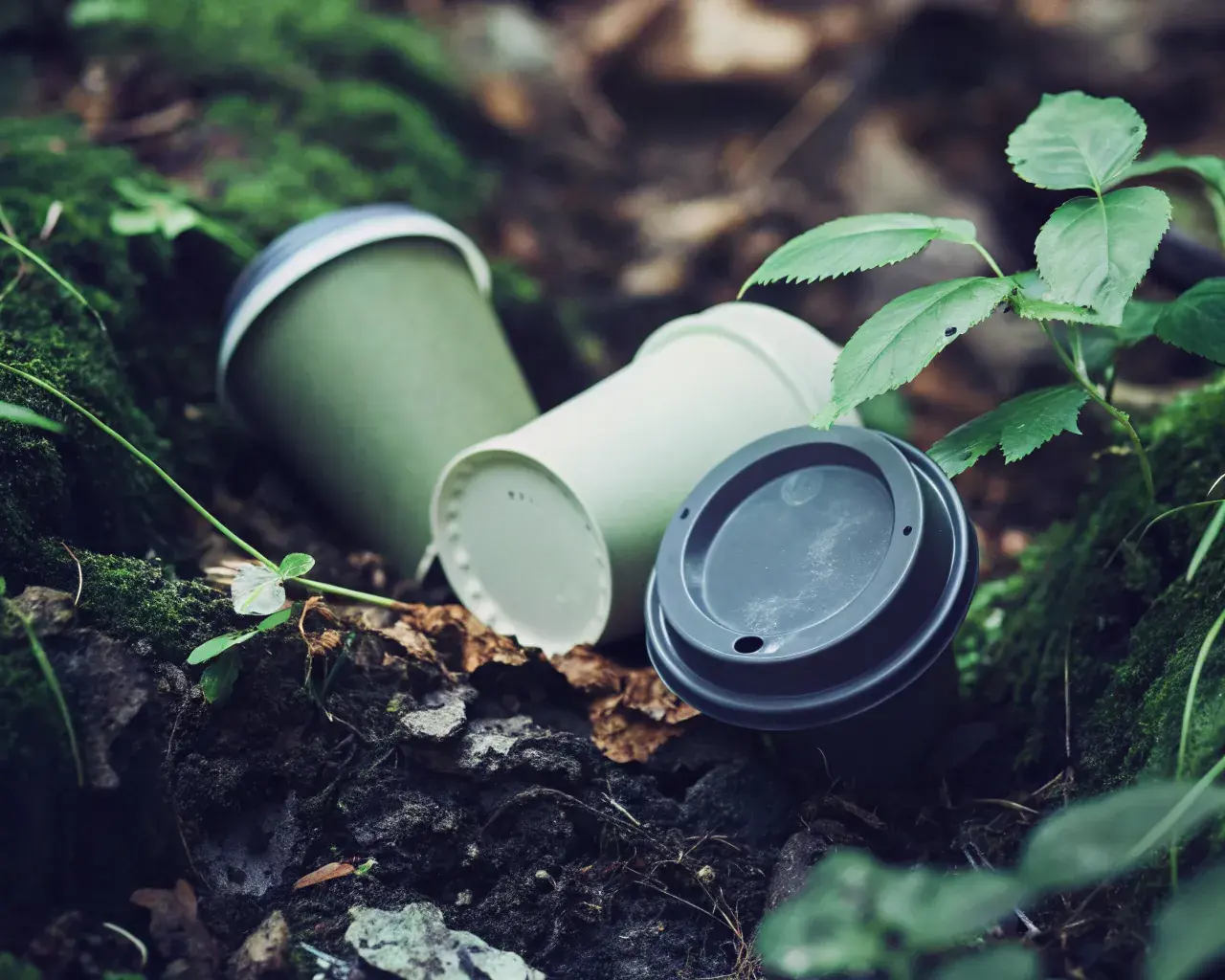
Over 500 billion single-use cups are discarded globally every year. The vast majority end up in landfills, waterways, and oceans — where conventional plastic takes more than 450 years to break down. PHA biodegradable lids and cups offer a fundamentally different outcome: they look, feel, and perform like plastic, but biodegrade completely in marine and soil environments without leaving a single microplastic particle behind.
This is not a compromise product. PHA biodegradable cups and lids match conventional plastic in rigidity, leak resistance, and temperature tolerance — and they meet the same food safety standards. The only meaningful difference is what happens at the end of their useful life. And that difference is everything.
500 Billion Cups. One Problem.
Single-use cups and lids are among the most ubiquitous pollutants on the planet. They are difficult to recycle — most paper cups feature a petroleum-based plastic lining that disqualifies them from recycling streams. Thin polypropylene and polystyrene lids are routinely rejected by recycling facilities. And when they reach waterways, they do not break down. They fragment. Over decades and centuries, those fragments become microplastics that enter the food chain.
Conventional plastic cups take over 450 years to break down in the environment — and even then, they do not disappear. They leave behind microplastic particles that accumulate in ocean sediment, in the tissues of marine animals, and in human bodies. The scale of this problem is not addressable through better recycling alone. It requires a material-level solution.
Cups Discarded Yearly
Over 500 billion single-use cups are thrown away globally each year — the majority ending up in landfills or oceans.
Petroleum Inputs
PHA manufacturing uses entirely renewable, plant-based raw materials with no fossil fuels or petroleum derivatives.
Years Plastic Persists
Conventional plastic cups take over 450 years to break down, fragmenting into microplastics along the way.
Biodegradable
Every component of PHA cups and lids is certified to fully biodegrade with no toxic byproducts in marine and soil environments.
Why PHA Is Different
Polyhydroxyalkanoate — PHA — is a biopolymer produced by bacteria. Certain bacterial strains, when fed organic feedstocks like canola-derived oils or sugarcane bagasse, store excess energy as biopolymer granules inside their cells. Those granules are harvested, refined, and processed into a bioplastic with performance properties comparable to conventional thermoplastics.
What sets PHA apart is its end-of-life profile. Unlike PLA — the other widely deployed bioplastic — PHA does not require industrial composting conditions to biodegrade. Naturally occurring bacteria and enzymes in soil, freshwater, home compost environments, and even the open ocean can recognize and metabolize PHA polymer chains. A PHA cup that ends up in the ocean will fully biodegrade in a matter of months. A conventional plastic cup in the same environment persists for centuries.
PHA also contains no petroleum, no BPA, no phthalates, and no petroleum-based plasticizers. The finished product is food-contact certified and safe for use with hot and cold beverages alike — without the chemical migration concerns associated with conventional plastics.
The Full Product Line
Pure Form Solution's PHA biodegradable cups and lids cover every single-use beverage and food service application — from morning coffee to fountain drinks to hot soup service.
Hot Beverage Cups (8–20 oz)
Available with double-wall insulation options. PHA's thermal resistance means no polyethylene lining is needed — the material itself provides the moisture barrier. Safe for coffee, tea, and soups up to 160°F.
Cold Beverage Cups (12–32 oz)
Crystal-clear or opaque formulations. Structural rigidity in chilled environments, condensation resistance, and compatibility with carbonated beverages. Drop-in replacement for conventional PETE cold cups.
Lids — Flat, Dome & Sip-Through
Precision snap-fit tolerances for leak-resistant seals. Available in flat sip-through lids for hot cups, dome lids for specialty cold beverages, and splash-resistant flat lids for fountain and cold brew applications.
Fountain Beverage Lids & Cups (16–32 oz)
Carbonation-reinforced walls that maintain structural integrity with sparkling water and sodas. Straw-compatible lid designs with tight-seal straw holes to prevent splash and lid displacement.
Soup Cups & Lids
Heat-resistant to 160°F. Leak-resistant lids designed for takeout and delivery soup service. Stackable construction for efficient storage and handling in high-volume operations.
From Plant to Cup: How PHA Is Made
The manufacturing process for PHA cups and lids begins entirely with renewable plant-based inputs — no petroleum, no fossil fuels, no synthetic chemistry.
- 01
Plant-Based Feedstock
Sugarcane bagasse and canola-derived PHA resin serve as the primary raw material inputs. Both are agricultural byproducts or sustainably cultivated crops that do not compete with food supply.
- 02
Bacterial Fermentation
Bacteria consume the plant-based feedstock and produce PHA biopolymer granules as intracellular energy storage. These granules are harvested, purified, and processed into PHA resin pellets.
- 03
Thermoforming & Injection Molding
PHA resin is processed using standard thermoforming and injection-molding equipment — the same machinery used to manufacture conventional plastic cups and lids. No facility retooling required.
- 04
Certification & Delivery
Finished cups and lids are certified for food safety, compostability, and marine biodegradability before shipment. TÜV Austria certifications cover industrial composting, home composting, marine, soil, and water biodegradation.
Performance Without Compromise
A biodegradable cup only creates environmental value if it actually performs well enough to replace the plastic alternative. Pure Form Solution's PHA cups and lids are designed to compete on performance — not just on sustainability claims.
Leak-Resistant
PHA cup walls and lid snap-fit tolerances are engineered to the same standards as conventional plastic food service packaging.
Temperature-Tolerant
PHA hot cups maintain structural integrity at 160–180°F without deforming or requiring a petroleum-based moisture barrier lining.
BPA & Petroleum Free
No BPA, phthalates, or petroleum-based plasticizers in any component — food-contact certified for complete beverage safety.
Marine-Safe
TÜV Austria OK Biodegradable MARINE certified — PHA fully biodegrades in open ocean without fragmenting into microplastics.
Home & Industrial Compostable
Certified for both home composting and industrial composting — not dependent on specialized infrastructure to biodegrade.
Drop-In Replacement
Compatible with standard food service equipment, dispensers, lid dispensers, and sleeve machines — no operational changes required.
Certifications That Matter
Environmental claims on packaging products vary widely in rigor. PHA cups and lids from Pure Form Solution are independently certified across multiple biodegradation environments — not just industrial composting.
OK Compost Industrial
Certified to biodegrade in industrial composting conditions within the required timeframe — compatible with commercial composting infrastructure.
OK Compost Home
Biodegrades in home compost at ambient temperatures — no industrial facility required. A certification that most PLA products cannot achieve.
OK Biodegradable MARINE
The gold standard for ocean safety. Certifies that PHA fully biodegrades in open marine environments — the certification PLA does not hold.
OK Biodegradable SOIL
Certified to biodegrade naturally in soil environments without leaving toxic residue or microplastic fragments.
OK Biobased
Independently verified plant-based content — confirms the renewable, petroleum-free origin of PHA raw materials.
The Business Case for PHA Cups and Lids
Food service operators increasingly face pressure from consumers, municipalities, and regulatory bodies to reduce single-use plastic. PHA cups and lids provide a direct path to meeting those expectations without operational disruption.
Because PHA cups and lids are drop-in replacements for conventional packaging — compatible with existing dispensers, sleeve machines, and lid dispensers — the transition requires no capital investment in new equipment. Staff training needs are minimal. Supply logistics remain unchanged.
The environmental positioning is also substantive, not greenwashed. When a business uses PHA cups and lids, it can make verifiable, certification-backed claims about its packaging: 100% petroleum-free, marine biodegradable, home compostable, and BPA-free. These claims are supported by TÜV Austria certification — not marketing language.
Every product we create is 100% compostable or biodegradable — no microplastics, no petroleum, no compromise.
— Pure Form Solution LLC
The Cup That Disappears
The problem with single-use cups is not that they exist — it's that they persist. A cup used for 20 minutes and discarded should not outlast the civilization that created it. PHA biodegradable cups and lids are the only single-use packaging that can genuinely claim otherwise.
In soil, in the ocean, in a home compost pile — PHA returns to the organic materials it was made from. No toxic residue. No microplastic fragments. No 450-year persistence in the environment. Just a cup that does its job and then disappears.
That is what a biodegradable product should actually mean. And it is what every Pure Form Solution cup and lid is certified to deliver.
Explore Pure Form Solution Products