
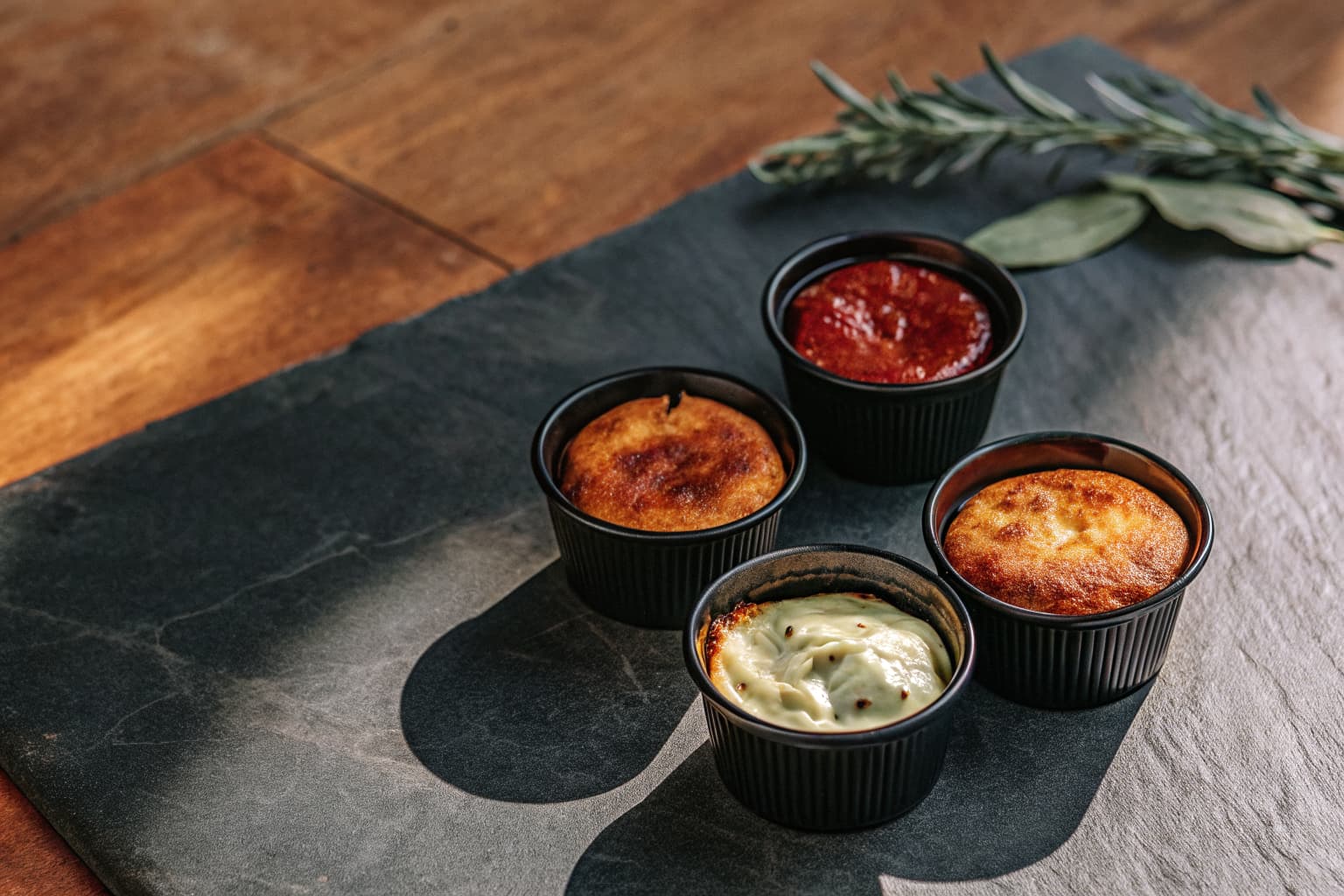
It rides along with almost every order of fries, wings, and dipping sauce sold in America — a tiny black cup, barely 2 ounces, holding a spoonful of ranch or ketchup. Used for a matter of minutes. Discarded without a second thought. And built from petroleum plastic engineered to survive for centuries. The souffle cup is the most overlooked piece of packaging in food service — and one of the largest by volume. PHA souffle cups change what happens after the sauce is gone.
Polyhydroxyalkanoates — PHA — are biopolymers produced by bacteria fermenting plant-based oils. Molded into the same 2 oz black souffle cup geometry that portions sauces, dressings, and condiments across restaurants, delis, and caterers everywhere, the result is a cup that performs identically to conventional plastic while biodegrading completely in marine, soil, home compost, and industrial composting environments. Same capacity. Same lid fit. Same grease resistance. Zero environmental debt.
40 Billion Portion Cups a Year. Fewer Than 3% Recycled.
Global manufacturing of souffle and portion cups exceeds 40 billion units annually. Quick-service restaurants, delis, caterers, stadiums, and grocery salad bars all rely on the same small black cup to portion sauces, dressings, and condiments at scale. Because they are small, dark-colored, and food-contaminated, souffle cups are functionally invisible to recycling infrastructure — most municipal sorting equipment cannot detect black plastic optically, and food residue disqualifies whatever does get sorted.
The result: fewer than 3% of conventional plastic souffle cups are ever captured by a recycling stream. The remaining 97%+ go to landfill, waterways, and coastlines, where a standard polypropylene or polystyrene souffle cup takes roughly 500 years to fully break down — fragmenting the entire time into microplastics that migrate into soil, sediment, and the food chain. Independent lab studies have found up to 1,420 microplastic particles released per liter from conventional single-use plastic cups under normal use conditions.
No collection program exists specifically for portion cups. No recycling stream reliably accepts small, dark, food-contaminated plastic at this scale. The only real fix is removing the plastic from the equation entirely — and PHA is the material built to do exactly that, at the volume the category demands.
40B+ manufactured annually
Global souffle and portion cup production exceeds 40 billion units per year across restaurants, delis, caterers, and grocery operations worldwide.
500 years to degrade
Conventional plastic souffle cups persist in landfill and marine environments for roughly five centuries, fragmenting into microplastics the entire time rather than biodegrading.
Under 3% recycled
Black coloring defeats optical sorting equipment and food contamination disqualifies the rest — fewer than 3% of plastic souffle cups ever reach a recycling stream.
What Makes PHA Different from Conventional Plastic
PHA is not a coated bioplastic or a starch blend that only degrades under narrow industrial conditions. It is a fully biologically produced polymer, synthesized by bacteria that naturally accumulate PHA inside their cells as an energy reserve. Once extracted and molded into souffle cup geometry, the resulting material behaves like rigid conventional plastic under every condition a portion cup encounters: grease from sauces, moisture from dressings, stacking pressure in dispensing racks, and a tight-fitting lid seal that has to hold through delivery and takeout handling.
The distinction is what happens after disposal. In any environment where organic matter breaks down — ocean water, soil, backyard compost, or an industrial composting facility — naturally occurring microorganisms recognize PHA as food and metabolize it at the polymer level. The output is water and CO₂. No microplastic fragments remain, no toxic residue, no lasting pollution. That is what separates PHA from every petroleum-derived alternative: disposal doesn't require new infrastructure, because biology already handles it.
For restaurant operators and portion-pack manufacturers, that means a souffle cup that performs identically on the filling line today — same 2 oz capacity, same diameter, same tight-fitting lid compatibility as standard black plastic cups — and returns completely to nature once it's thrown away. No changes to dispensing equipment. No changes to lid inventory. No performance compromise.
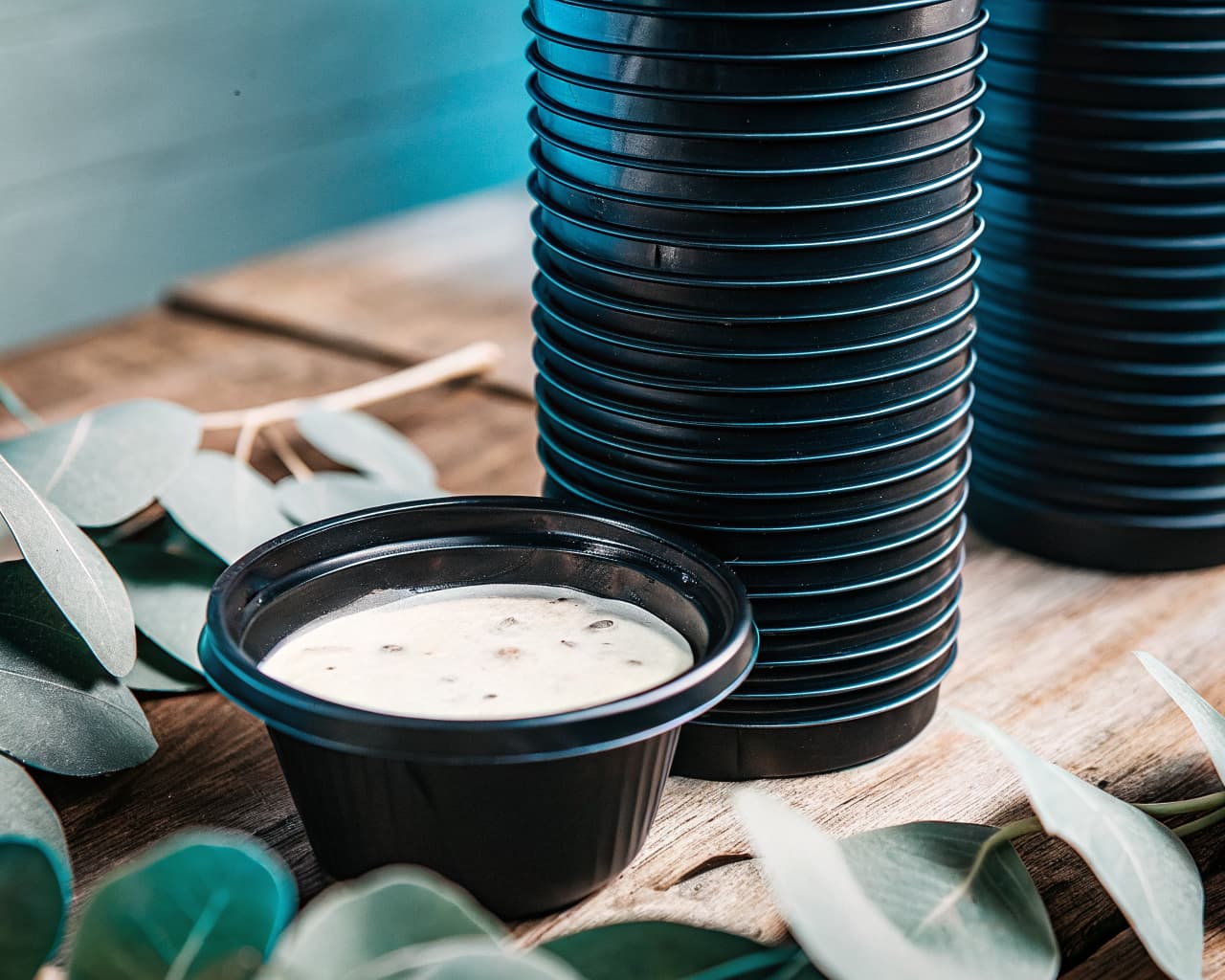
Six Advantages of PHA Souffle Cups for Food Service Operators
For restaurant owners, portion-pack manufacturers, and procurement teams evaluating sustainability commitments, PHA souffle cups deliver across every dimension that matters.
- 01
Exact Drop-In Replacement — No Line Changes
PHA souffle cups match conventional black plastic cups exactly in 2 oz capacity, diameter, and lid fit. They run on existing portioning, filling, and lidding lines without any equipment modification. The switch is operationally invisible.
- 02
Grease-Resistant and Leak-Proof
PHA holds its shape and seal in direct contact with oily sauces, dressings, and dips — from the moment it's filled through delivery and takeout handling — without softening, leaking, or losing its tight-fitting lid seal.
- 03
Certified Biodegradability Across All Environments
PHA souffle cups are certified for marine biodegradability, soil biodegradability, home composting, and industrial composting. Conventional black plastic cups cannot qualify for any of these certifications regardless of formulation.
- 04
Zero Microplastics at End of Life
When PHA is metabolized by naturally occurring microorganisms, the byproducts are water and CO₂ — no polymer fragments, no microplastic accumulation in sediment or waterways. For operations tracking ESG metrics or facing single-use plastics regulation, that distinction is documentable and material.
- 05
BPA-Free and Food-Contact Certified
PHA is produced biologically without petroleum feedstocks, BPA, or phthalates, and carries food-contact certification for direct contact with sauces, dressings, and condiments. No chemical migration concern for what your customers are eating.
- 06
Regulatory and Brand Positioning
Single-use plastics regulation continues to expand across states and municipalities, with portion cups increasingly named alongside straws and bags. Switching to PHA now gets ahead of upcoming mandates and gives your marketing team an authentic, verifiable sustainability claim for one of the most frequently touched items in your packaging mix.
PHA vs. Conventional Plastic: A Direct Comparison
The souffle cup category has essentially never had a genuine sustainability alternative before PHA. Paper cups can't hold liquid sauces reliably without a plastic lining, and no prior bioplastic has offered the grease resistance, food-contact certification, and drop-in dimensional match that conventional plastic delivers. PHA changes that.
Conventional Black Plastic
Strength
Proven grease resistance, exact dimensional match to standard portioning and lidding equipment, low unit cost at scale, decades of food-contact approval
Limitation
About 500 years to degrade in landfill or ocean. Generates microplastics throughout. Petroleum-derived. Black coloring defeats recycling sort equipment. Increasingly regulated.
Best For
Applications where sustainability impact is not a consideration
PHA Souffle Cups
Strength
Same 2 oz capacity, diameter, and lid fit as conventional cups. Grease-resistant and leak-proof. Certified marine, soil, home, and industrial compostable. Zero microplastics. BPA-free.
Limitation
Higher unit cost vs. conventional plastic — partially offset by regulatory future-proofing, ESG reporting value, and sustainability marketing differentiation
Best For
Any restaurant, portion-pack manufacturer, caterer, or grocery deli committed to genuine sustainable packaging without operational compromise
The Certifications Behind PHA's Claims
Sustainability language on food service packaging has a credibility problem. Products labeled 'eco-friendly' or 'compostable' frequently rest on self-reported claims, or on certifications that only apply under industrial facility conditions that almost never occur at real-world disposal. PHA souffle cups from Pure Form Solution are certified for biodegradability across marine, soil, home compost, and industrial composting environments — independently verified, not self-reported.
Marine biodegradability certification verifies that PHA is metabolized by microorganisms in seawater at realistic ocean temperatures without producing toxic residue or microplastic fragments. Soil biodegradability certification verifies terrestrial breakdown without facility infrastructure. Home compostability certification verifies performance in a backyard composter at ambient temperature. These are documented third-party test results, not marketing language.
For restaurant chains with sustainability commitments, portion-pack manufacturers with ESG reporting obligations, or independent operators who want an authentic marketing claim for their condiment packaging, PHA souffle cups provide documentation no conventional plastic cup can match.
"A souffle cup gets used for maybe five minutes and then it's supposed to disappear. Conventional plastic can't do that — it just breaks apart forever. PHA is the first material that actually finishes the job."
— Jim McGinnis, V.P. of Marketing & Sales, Pure Form Solution LLC
Pure Form Solution's PHA Souffle Cup Program
Pure Form Solution's PHA Biodegradable Souffle Cups are available in wholesale volumes sized for independent restaurants, national QSR chains, portion-pack manufacturers, caterers, and grocery delis. The standard 2 oz black cup with tight-fitting lid compatibility covers the vast majority of existing dispensing and portioning equipment. Free shipping is available on orders of $50 and above, and sample packs are available for operations evaluating the switch before committing to volume.
Our Food Service Sustainability Program pairs each operator with a consultant who evaluates your current portion cup usage, confirms compatibility with your filling and lidding equipment, and provides the certification documentation your marketing and ESG reporting teams need. For chains and franchise networks, we coordinate multi-location rollouts with unified certification and supply chain reporting.
The switch requires no operational change — same capacity, same lid, same line speed. What changes is where those 40 billion souffle cups a year end up. Instead of five centuries fragmenting in a landfill or an ocean, they return to the organic matter they came from. For a product used in nearly every to-go order your kitchen sends out, that's an impact that compounds fast.
40 Billion Small Cups, One Big Opportunity
The souffle cup is easy to overlook — it's small, it's cheap, and it's gone in minutes. That's exactly why it has been allowed to accumulate at 40 billion units a year without the same scrutiny straws and bags have gotten. The volume is enormous. The visibility has been almost nonexistent.
PHA souffle cups don't ask operators to accept a performance compromise to fix that. They're the same cup — same capacity, same lid, same dispensing workflow — made from a material biology can reclaim instead of accumulate. For restaurants, caterers, and portion-pack manufacturers ready to remove plastic from their condiment packaging without disrupting operations, the switch is available today.
Forty billion a year. Each one now a choice.
Explore Pure Form Solution Products