
Understanding PHA Biodegradation Certifications and Testing Standards
By Pure Form Solution · Published
Why certification matters when you buy biodegradable packaging
Words like biodegradable, compostable and eco-friendly are easy to print on a box and hard to verify. For a business, an unsupported claim creates reputational and sometimes legal risk. Certification gives you an independent test result you can point to, which is why serious buyers of PHA packaging ask for certificates before they ask for prices.
A certificate is not a general badge of virtue, though. It is a statement that a specific material or product passed a defined test under defined conditions. Reading it correctly is the difference between an accurate sustainability claim and a misleading one.
The TÜV Austria marks used for PHA products
Our PHA materials are tested by TÜV Austria. The marks you will see on product documentation fall into a few groups.
OK Compost Industrial
Verifies that a product breaks down in an industrial composting facility within the time and conditions set by the standard. This is the usual certification for PLA products and also applies to qualifying PHA items.
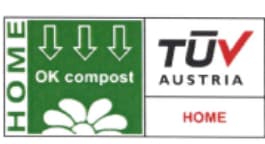
OK Compost Home
Verifies breakdown under the lower and more variable temperatures of a home compost pile. It is a more demanding test than industrial composting, and only products that pass it may carry the mark.
OK Biodegradable Soil, Water and Marine
Verify biodegradation in soil, fresh water or marine environments under laboratory test conditions. They describe how a material behaves in that medium during testing, and do not make littering acceptable.
OK Biobased
This mark is different: it measures the share of renewable carbon in a product rather than how it breaks down.
What a certificate does and does not tell you
First, a certificate covers a named product or material grade. A mark earned by one PHA straw does not automatically extend to a PHA container, a coffee bag or a different thickness. Ask for the certificate that matches the exact item and supplier you are buying.
Second, a certificate covers specific conditions. OK Compost Home does not mean a product will vanish in a backyard in a week, and a marine mark does not mean it is safe to leave in the ocean. The time limits and temperatures in the standard are part of the claim.
Third, biodegradation certification is not the same as food-contact approval or pharmaceutical suitability. Those are separate questions governed by separate rules and documents. If you plan to use packaging for food or healthcare, request the relevant documentation for your market.
How to read a certificate in practice
Check the product description
Confirm the certificate names the product or material you are buying, and the producer or supplier.
Check the scope and conditions
Look at which environment it covers (industrial, home, soil, water or marine) and any thickness or formulation limits.
Check validity
Certificates have dates and can be updated. Ask for the current version.
Match your disposal route
A compostable item only delivers its benefit if customers can reach the right disposal route. Industrial composting may not exist locally, and home composting depends on the customer.
Making accurate claims to your customers
Use the certification wording rather than a paraphrase. Say that a product is certified home compostable under TÜV Austria OK Compost Home only if the certificate says so. Where a product holds a narrower certification, state that narrower claim. Avoid promising specific environmental outcomes that you cannot substantiate, and give customers clear disposal instructions on or near the packaging.
This approach also protects you in procurement. If a customer, auditor or regulator asks how you know a product is compostable, you can hand over a certificate instead of a marketing sentence.
Getting documentation from Pure Form Solution
You can review the marks we hold on our certifications page, and each product page notes the certifications that apply to that item. For the certificates and technical documents behind a specific product, request them through the quote form and tell us which items you are evaluating. Our PHA packaging solutions hub also explains how PHA differs from PLA and conventional plastic so your team can compare materials with the right context.
Explore related solutions
Keep reading
Ready to evaluate PHA packaging for your business?
Request wholesale pricing, samples or custom packaging information.